
White Papers

Scaling Onboard Software Without Scaling Risk
A Platform Strategy for Non-Safety-Critical Aerospace Systems
Approximate Reading Time: 5 Minutes
Start here if you’re looking for a quick introduction to:
Causes of “scaling friction” for onboard NSC software
Strategic outcomes of disciplined, platform-based thinking for NSC systems
5-Step onboard cloud-native playbook - milestones and objectives
Common failure points to avoid

Platform Engineering for Non-Safety-Critical Onboard Systems: Adopting a Cloud-Native Approach
Version 1.2 (February, 2026)
Approximate Reading Time: 50 minutes
This document is intended for technical directors, VPs of engineering, and system/software architects to better understand key concepts and design patterns for cloud-native, non-safety-critical (NSC) software platforms onboard aircraft and spacecraft - which are subject to common size, weight, and power (SWaP) constraints; and, must co-exist with certified safety-critical (SC) components without assuming responsibility for their certification or assurance.
After reading this paper, readers will be equipped with the following:
Firm understanding of the business and technical impacts of inadequate NSC platforms.
Fluency with essential cloud-native concepts and terminology to drive cloud-native platform engineering initiatives.
Familiarity with fundamental design patterns and implementations that could save the reader months’ worth of R&D. And, to promote early detection of anti-patterns that could otherwise result in significant delays.
Platform as a Service for Onboard Aerospace Software Systems
Organizational Model and Design Approaches
Version 1.0 (February, 2026)
Approximate Reading Time: 35 minutes
This document is intended for CTOs, technical directors, and VPs of engineering who are seeking to maximize their software platform’s portability, reuse, and scale across a portfolio of programs, vehicles, and missions.
After reading this paper, readers will be equipped with the following:
Deep understanding of business and technical challenges that share a root cause of deficient software platforms.
Fluency with the terminology, objectives, and characteristics of a PaaS solution for onboard software systems.
Familiarity with organizational models and supporting engineering paradigms necessary for successful PaaS solution development and delivery.
Familiarity with essential business and technical approaches to modular open systems, system interoperability, reduced certification scope, high-velocity non-safety-critical software development, and streamlined security architecture and vulnerability management.
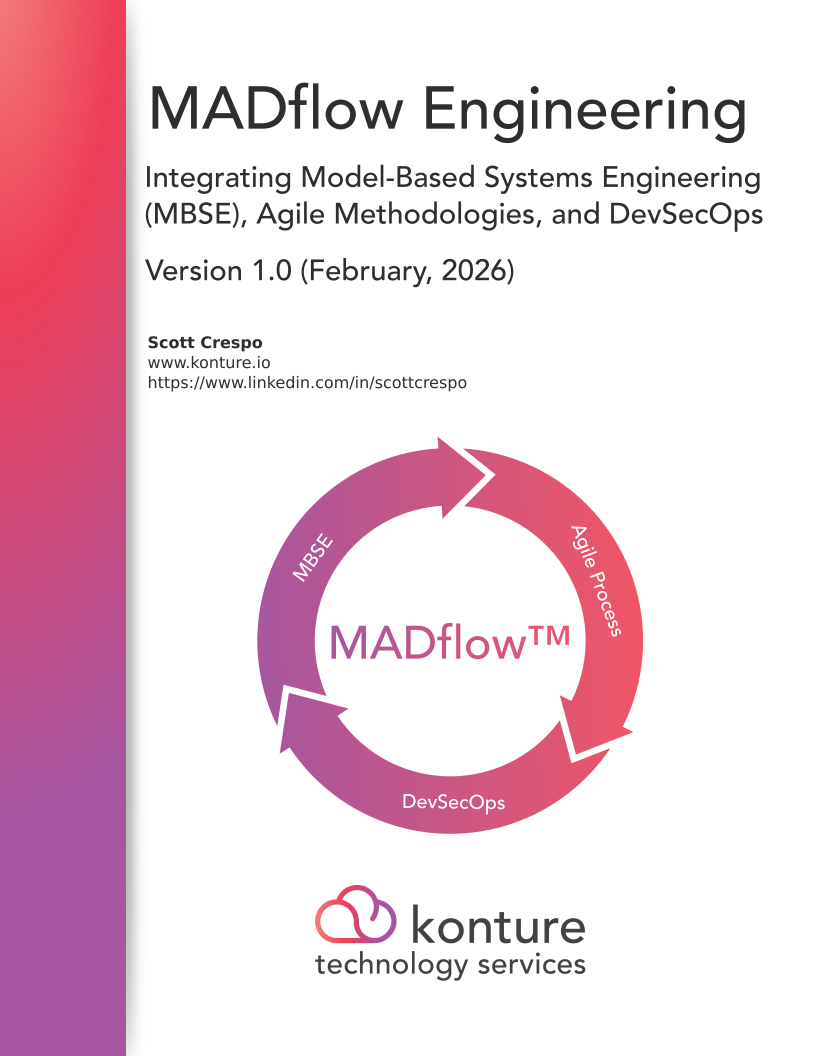

MADflow Engineering
Integrating Model-Based Systems Engineering (MBSE), Agile Methodologies, and DevSecOps
Version 1.0 (February, 2026)
Approximate Reading Time: 20 minutes
MADflow™ is a simple methodology that integrates Model-Based Systems Engineering, Agile Development Processes, and DevSecOps (MAD) into a cyclical flow of activities and artifact exchanges. By implementing MADflow, organizations can promote interoperability and efficient exchanges between the MAD activities, thereby mitigating problems of communication overhead, integration failures, late discovery of deficiencies, and the absence of an authoritative single source of truth for the system’s current and future states.
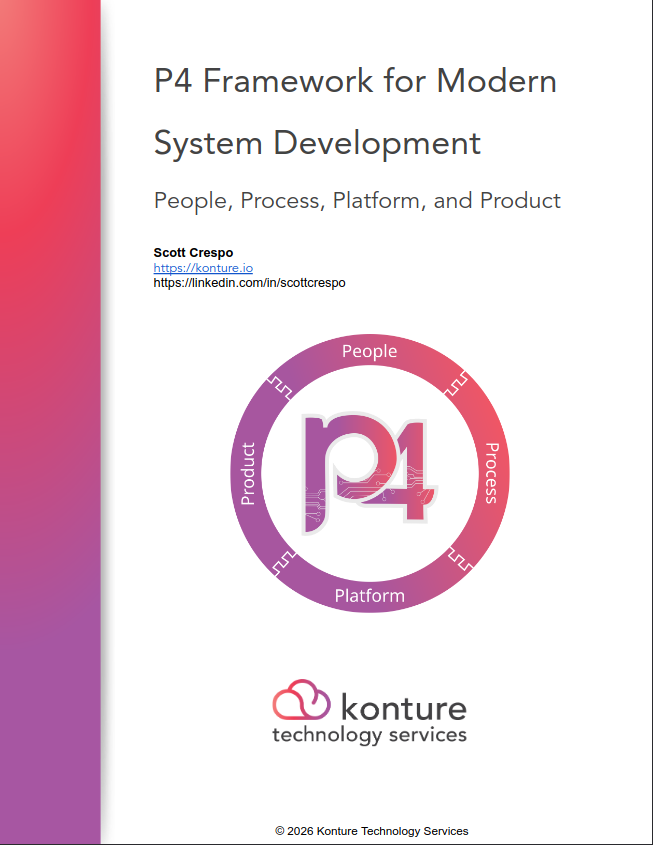
P4 Framework for Modern System Development
People, Process, Platform, and Product
Version 1.0
Approximate Reading Time: 10 minutes
Konture’s P4 Framework introduces four interdependent domains: People, Process, Platform, and Product; which serve as first-order concerns for modern system development, problem solving, and organizational change. P4 is an evolution of the traditional People, Process, and Technology Framework (PPT), which has its roots in the Diamond Model originally developed by Harold Leavitt in the 1960s. P4 splits PPT’s Technology domain into Platform and Product - an acknowledgement of the increasing prominence of technology platforms to support a system’s development and real-world operation. Compared to the PPT Framework and its many variants, The P4 Framework is particularly useful for organizations developing software-intensive edge systems (e.g., aerospace, automotive, and energy) where the development and operating environments have unique characteristics and constraints.